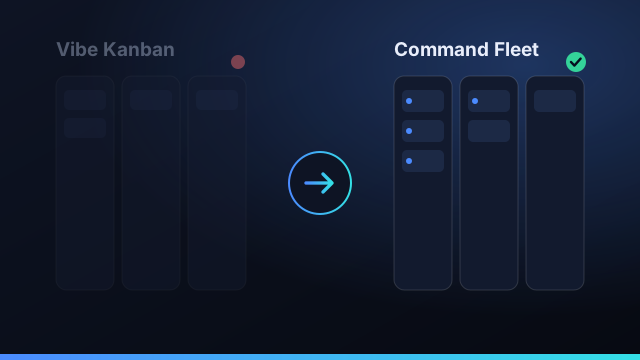
If you landed here, you've probably noticed the same thing we did: Vibe Kanban is winding down. The project's momentum has stalled and its website no longer resolves, which leaves a lot of builders looking for somewhere to take their workflow. The good news is that the idea Vibe Kanban championed — a Kanban board that orchestrates real coding agents — is very much alive. The better news is that you can now have it with a portfolio layer, agent choice, and an autonomous build loop on top.
This guide covers what made Vibe Kanban worth using, what to look for in a replacement, and an honest walkthrough of where Command Fleet fits.
What Vibe Kanban got right
Vibe Kanban popularized a simple, powerful framing: stop thinking of an AI agent as a chat window and start thinking of it as a worker you assign cards to. A few things made it click:
- Board-driven work. Tasks moved across columns, so you could see what an agent was doing at a glance.
- Multiple agents. It wasn't locked to a single vendor — you could point it at different coding agents.
- Local execution. It ran on your machine and worked against your real git repositories.
That combination — board + multiple agents + local — is exactly the right foundation. The question is what to build on top of it.
Migrating now? Your projects are just git repositories on disk. Nothing about Vibe Kanban locked your code in, so moving to another local tool is mostly a matter of pointing the new app at the same folders.
What to look for in a Vibe Kanban alternative
If you're choosing a replacement you'll live in every day, weigh it against five things:
- Is it maintained? The whole reason you're here. Pick something with an active roadmap.
- Does it scale past one repo? Most tools assume a single project. If you ship a portfolio, you want workspaces and projects, not a hundred browser tabs.
- Is it agent-agnostic? Claude Code, Codex, and Gemini are each better at different things. Lock-in costs you flexibility.
- Is it safe to run unattended? Isolated git worktrees, an in-app diff, and a review-before-merge step are non-negotiable once agents start editing real code.
- Does it stay local? If your code or your clients' code can't leave your machine, a cloud agent is a non-starter.
Where Command Fleet fits
Command Fleet keeps everything that made the Kanban-over-agents model great and extends it for people who run more than one thing.
It's built for a portfolio, not a repo
Command Fleet organizes work as organizations → workspaces → projects → tasks. Each project gets its own board, and a home dashboard rolls up what's running, what's waiting on review, and a live activity feed across everything. If you're a solo founder with seven apps or an agency with a workspace per client, this is the layer you were missing.
It's genuinely agent-agnostic
Dispatch any task to Claude Code, Codex, or Gemini — chosen per task and switchable anytime, with an optional per-run model override. Use a cheaper model for boilerplate and the strongest one for the gnarly refactor, all from the same board.
It's safe by default
Every run happens in its own git worktree on a dedicated branch. Parallel agents never clobber each other or your working tree. When a run finishes you get an in-app diff with +/- coloring and a one-click merge — or you discard it. An optional verify gate can run your build and tests and bounce a "done" task back to review if it fails.
It can build the whole thing
This is the part Vibe Kanban never had. Describe an app to the workspace manager and it scaffolds the project from a stack pack, breaks the work into an ordered task graph, dispatches each task to an agent, auto-retries failures, merges finished branches, and can deploy — across six stack packs from Firebase to Fly. You stay the reviewer; it does the typing.
It stays on your machine
Projects, data, and API keys never leave your computer. Keys live in your OS credential vault, and a per-project secrets vault is never sent to any agent. You bring your own Claude, Codex, or Gemini subscription, so you're never double-charged for model usage.
Side by side
| Capability | Command Fleet | Vibe Kanban |
|---|---|---|
| Kanban over real agents | Yes | Yes |
| Multiple agents | Claude · Codex · Gemini | Multi |
| Local-first | Yes | Yes |
| Many projects / portfolio | Yes | Single-repo |
| Autonomous plan → build → deploy | Yes | No |
| Built-in preview & deploy | 6 stack packs | No |
| Maintained & available | Active | Winding down |
How to migrate in three steps
- Install Command Fleet and create a workspace (one per client or product line works well).
- Add your existing projects by pointing Command Fleet at the same git folders you used before. Set a setup script (like
pnpm install) so fresh worktrees build. - Recreate your active cards as tasks, pick an agent, and dispatch. Review the diff, merge, and you're back in motion — now with a board per project instead of one big list.
If Vibe Kanban taught the industry that agents are workers you assign cards to, Command Fleet is what that idea looks like once you're running a whole fleet.
Why builders are moving on from Vibe Kanban in 2026
The reason most people search for a Vibe Kanban alternative is simple: a tool you live in every day needs an active roadmap, and Vibe Kanban's momentum has stalled while its website no longer resolves. But the deeper reason is that the bar has moved. In 2026 the AI coding agents themselves — Claude Code, Codex, and Gemini — are dramatically more capable than when the Kanban-over-agents idea first appeared, and far more builders are running a portfolio of apps rather than a single repository. A board that orchestrates one project at a time was a great start, but it is no longer the ceiling.
So the modern checklist for a Vibe Kanban alternative is stricter than "does it have columns?" It should be actively maintained, scale across many projects with workspaces, stay agent-agnostic so you can match the model to the task, isolate every run in its own git worktree with a review gate, keep your code local-first, and — increasingly — do more than move cards: it should be able to scaffold, build, review, and deploy. That is exactly the gap Command Fleet was designed to fill.
Beyond a board: the autonomous build loop
Moving cards from "To do" to "Done" is table stakes. The real leap is what happens between those columns. Command Fleet's autonomous build loop turns a one-sentence description into a planned, built, reviewed, and deployable app: it scaffolds the project from a stack pack, plans a dependency-aware task graph, runs the ready tasks in parallel across isolated git worktrees, retries failures a set number of times, merges finished branches in dependency order, and can deploy to Firebase, Vercel, Netlify, Cloudflare, Supabase, or Fly.
The task graph is the unlock that a flat Kanban list never had. By recording which tasks depend on which, the loop knows what can run at the same time and what has to wait — which is what makes many AI coding agents safe to run in parallel without stepping on each other. You stay the reviewer at every gate: the loop does the typing and the plumbing, and anything it cannot resolve lands in your review queue with its full history.
A Vibe Kanban alternative for founders and agencies
If you are a solo founder shipping a portfolio of side projects, an agency running a workspace per client, or an indie hacker who wants to bring your own Claude, Codex, or Gemini subscription with no markup, a single-repo board was always going to be a tight fit. Command Fleet is the Vibe Kanban alternative built for that scale: an organization → workspaces → projects → tasks hierarchy, a home dashboard that rolls up every running task and review queue across the whole portfolio, and a board per project so you never lose the thread. For agencies in particular, a workspace per client keeps each client's code, context, and secrets cleanly separated and confidential on your own machine — a much easier answer to "where does our code go?" than explaining a chain of cloud services.
Feature deep dive: board, agents, and deploy
It's worth looking at the three layers a Vibe Kanban alternative needs to nail. The board is where Vibe Kanban started, and Command Fleet keeps it: every project gets To do, In progress, In review, and Done columns, with each card carrying its task, its assigned agent, and — once it runs — its diff. The agents layer is where being agent-agnostic pays off: you dispatch each card to Claude Code, Codex, or Gemini, with an optional per-run model override, so you route the strongest model to the hard refactor and a cheaper one to boilerplate. And the deploy layer is the one a static board never had: from the same app you can scaffold from a stack pack and ship to Firebase, Vercel, Netlify, Cloudflare, Supabase, or Fly, with preview and deploy sharing one manifest. Board, agents, and deploy in one local-first tool is what "Kanban over agents, grown up" actually looks like.
Underneath all three sits the safety model: every run is isolated in its own git worktree, an optional verify gate runs your build and tests, and a cross-project review queue means nothing merges without your sign-off. That combination — visible board, flexible agents, built-in deploy, and isolation with review — is the practical checklist most people are really running through when they search for a Vibe Kanban alternative.
Ownership, cost, and lock-in
One of the quiet reasons the Kanban-over-agents idea resonated was ownership: it ran on your machine against your real git repositories, so your code was yours. Any worthwhile Vibe Kanban alternative has to preserve that, and Command Fleet does — it's local-first, so projects, data, and API keys never leave your computer, your task history is a file on disk, and there's no lock-in if you ever stop. On cost, being bring-your-own matters: you connect your existing Claude, Codex, or Gemini subscription and pay the providers directly, with no markup layered on every run. You're never double-charged for model usage, and you're never tied to a single vendor's model when another would do the job better. For a tool you live in every day, owning your code, your data, and your model choice isn't a nice-to-have — it's the whole point.
Frequently asked questions
Is Vibe Kanban shutting down?
Its momentum has stalled and its website no longer resolves, so most users are treating it as winding down and moving to a maintained alternative. Your projects are just git repositories on disk, so nothing about it locks your code in.
What's the best Vibe Kanban alternative in 2026?
Look for a tool that's actively maintained, scales past a single repo, is agent-agnostic across Claude Code, Codex and Gemini, runs each task in an isolated git worktree with review-before-merge, and stays local. Command Fleet was built around exactly those five criteria.
Can I keep my existing projects when I switch?
Yes. Because Vibe Kanban worked against local git folders, migrating is mostly pointing the new app at the same directories and adding a setup script so fresh worktrees build.
Is Command Fleet free to try?
Yes — there's a free 7-day trial with no credit card, and you bring your own Claude, Codex or Gemini subscription, so you're never double-charged for model usage.
Pick up where Vibe Kanban left off
Portfolio-scale, agent-agnostic, autonomous, and 100% local. Free for 7 days, no credit card.