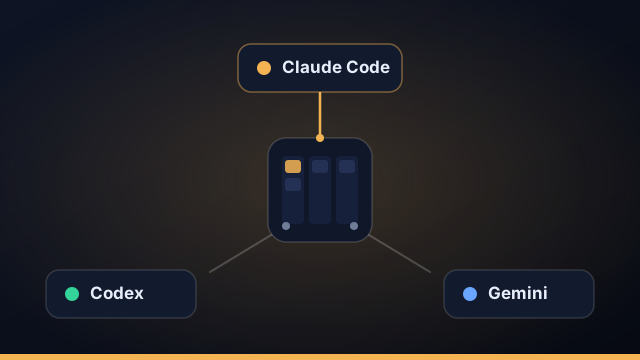
The "which coding agent is best" debate has a boring but correct answer: it depends on the task. Each of the big three is excellent, each has a personality, and the cost of switching is low when your tool lets you choose per task. Here's how we think about matching the agent to the job.
The case against picking just one
Standardizing on a single agent feels tidy, but it leaves value on the table. Models differ in how they plan, how aggressively they refactor, how they handle huge contexts, and what they cost per run. If you can assign Claude Code to one card and Gemini to the next, you optimize each task instead of compromising across all of them.
The meta-skill isn't loyalty to one agent — it's knowing which to reach for, and being able to switch in one click.
Claude Code
A strong default for substantial, multi-file work: refactors, feature builds, and anything where careful planning and faithful diffs matter. It tends to be methodical and explains its reasoning, which makes the review step smoother. Reach for it when correctness and code quality outweigh raw speed.
Codex
A capable generalist that's comfortable driving a shell and iterating quickly. Good for well-scoped engineering tasks, test scaffolding, and tight build-run-fix loops where you want momentum. Worth assigning when the task is concrete and you value throughput.
Gemini
Handy for large-context work and quick passes, and a useful second opinion when another agent gets stuck. A reasonable pick for exploration, broad codebase questions, and high-volume routine edits where cost-efficiency matters.
A simple routing heuristic
- Big refactor or new feature you'll review carefully → Claude Code.
- Concrete task with a fast feedback loop → Codex.
- Exploration, large context, or high-volume small edits → Gemini.
- Stuck? Re-dispatch the same task to a different agent — a fresh perspective often breaks the logjam.
Why this works better in one app
Routing only pays off if switching is frictionless. In Command Fleet the agent is a per-task choice with an optional model override, and every run is isolated in its own worktree — so you can fan the same task out to two agents, compare the diffs, and merge the better one. You bring your own subscriptions for all three, so there's no penalty for using whichever fits.
Don't marry an agent. Assemble a crew and assign the work.
Benchmark Claude Code, Codex, and Gemini on your own codebase
General leaderboards are a weak proxy for "which AI coding agent is best for my work." The benchmark that matters is your own repository. The cleanest way to run it: take a real, well-scoped task — a bug fix, a small feature, a refactor — and dispatch the same task to Claude Code, Codex, and Gemini in parallel, each in its own isolated git worktree so they don't collide. Then compare the diffs. You'll quickly see which agent plans more carefully, which over-reaches, which writes tests without being asked, and which matches your codebase's style. Do that across a handful of task types and you'll have a routing intuition no public benchmark can give you — grounded in your code, your conventions, and your definition of "done."
Cost and speed: match the model to the task
Picking an agent isn't only about quality; it's about matching power to difficulty. Dependency bumps, copy tweaks, and test scaffolding don't need your strongest, most expensive model — a cheaper, faster one ships them just as well. The gnarly multi-file refactor is where it pays to reach for the most capable agent. Because the cost of switching is low when your tool lets you choose per task, you can optimize each job instead of compromising across all of them: cheap models for the routine, the strongest for the hard problems, a fresh agent when one gets stuck. Measured by cost per shipped feature — the number that actually matters — routing this way usually comes out well ahead of standardizing on a single model.
Why an agent-agnostic orchestrator beats picking just one
The conclusion of every "Claude Code vs Codex vs Gemini" debate is the same: don't marry an agent, assemble a crew. That only pays off, though, if switching is frictionless. In Command Fleet the agent is a per-task choice with an optional per-run model override, and every run is isolated in its own worktree — so you can fan a single task out to two agents, compare the diffs, and merge the better one, all from one board. You bring your own subscriptions for all three, so there's no penalty for using whichever fits. An agent-agnostic orchestrator turns "which one is best?" from a one-time bet into a per-task decision you make in a click.
Quick reference: which agent for which task
Use this as a starting routing heuristic, then refine it by benchmarking on your own codebase — the right answer is always partly specific to your project and conventions.
- Big refactor or new feature you'll review carefully → reach for Claude Code, which tends to plan methodically and produce faithful, reviewable diffs.
- Concrete, well-scoped task with a fast build-run-fix loop → Codex is a strong pick when you value momentum and throughput.
- Exploration, very large context, or high-volume routine edits → Gemini is handy for breadth and cost-efficiency.
- An agent is stuck → re-dispatch the same task to a different model; a fresh perspective often breaks the logjam at no extra setup cost.
- A high-stakes change → fan it out to two agents, compare the diffs, and merge the better one.
The meta-point is that "best" is a per-task question, not a one-time bet. With an agent-agnostic orchestrator like Command Fleet — where the agent is a per-task choice with an optional model override and every run is isolated — you apply this routing in a click, on your own Claude, Codex, and Gemini subscriptions, with no markup.
Frequently asked questions
Which coding agent is best for big refactors?
Claude Code is a strong default for substantial, multi-file work where careful planning and faithful diffs matter and you'll review the result closely.
Do I have to pick just one agent?
No — that leaves value on the table. The meta-skill is routing: assign Claude Code to one card and Gemini to the next, optimizing each task instead of compromising across all of them.
Do I need three separate subscriptions?
You bring your own subscriptions for whichever agents you use. In Command Fleet the agent is a per-task choice with an optional model override, so there's no penalty for using whichever fits.
What should I do when an agent gets stuck?
Re-dispatch the same task to a different agent. Each run is isolated in its own worktree, so a fresh perspective often breaks the logjam without risking your main branch.
Use all three, per task
Command Fleet dispatches each task to Claude Code, Codex, or Gemini — your choice, your subscriptions. Free for 7 days.