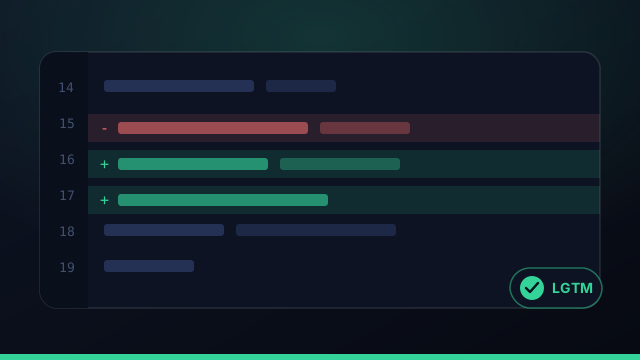
When agents write the code, the bottleneck moves to review. That's the good news and the catch in one sentence: you can generate ten changes in the time it used to take to write one, but every one of them still has to be right before it ships. Here's how to review AI-generated code quickly and safely, so the review step accelerates your work instead of becoming the new traffic jam.
Why AI-generated code still needs a human
Modern agents are good — good enough that their output looks finished even when it isn't. The failure modes are specific and worth naming: plausible-but-wrong logic, scope creep (refactors you didn't ask for), silent breakage elsewhere in the codebase, missing tests, and security gaps. None of these are obvious from a confident summary. All of them are visible in the diff.
Read the diff, not the explanation
Agents write persuasive summaries of their own work. The summary is a hypothesis; the diff is the truth. Read what actually changed line by line. If the explanation and the diff disagree, believe the diff.
Run a verify gate before your eyes
Don't spend human attention catching things a machine can catch. A verify gate — your build plus your test suite — runs first, automatically. If it fails, the task bounces back (or auto-retries) before it ever reaches you. Your review then starts from a change that already compiles and passes, so your judgment goes to design and correctness, not typos.
If you can't tell what a diff does in about two minutes, that's a finding. Send it back for a smaller, clearer change rather than approving on faith.
A six-point review checklist
- Scope: does the change match the task — nothing more, nothing less?
- Tests: is there coverage for the new behavior, and does it actually exercise it?
- Creep: any unrequested refactors or formatting churn hiding the real change?
- Edges: are error paths and edge cases handled, not just the happy path?
- Secrets & safety: any logged tokens, broad permissions, or injection-prone inputs?
- Fit: does it read like the surrounding code, or like a transplant?
Send it back vs fix it yourself
For anything an agent can redo with a clearer instruction, send it back — that keeps you out of the weeds and improves the next attempt. For small judgment calls, just fix them yourself; it's faster than a round trip. And when an agent is stuck in a loop, re-dispatch the same task to a different agent: a fresh perspective often clears the logjam.
Make review fast: one queue across projects
The highest-leverage habit is a single "needs review" queue spanning every project. Each finished run waits there with its diff and full history, so review becomes a focused pass rather than a hunt through a dozen branches. Clear the queue once a day and nothing rots.
Shipping speed is gated by review speed. Optimize the review, and the agents take care of the rest.
Frequently asked questions
Do I really need to review AI-generated code?
Yes. Agents produce plausible code that can be subtly wrong, over-scoped, or silently break something else. A diff review plus an automated verify gate catches the issues before they reach your main branch.
What should I look for when reviewing an agent's pull request?
Start with the diff, not the agent's summary: check the change matches the task, watch for unrequested scope creep, confirm tests actually exercise the new behavior, and look for security and edge-case gaps the agent glossed over.
What is a verify gate?
An automated check — your build and test suite — that runs before you review. If it fails, the task bounces back or auto-retries, so you only spend human attention on changes that already pass the basics.
Should I fix the agent's code myself or send it back?
Send it back for anything the agent can re-attempt with a clearer instruction; fix small judgment calls yourself. Re-dispatching with feedback keeps you out of the weeds and often produces a cleaner next attempt.
Review once, merge with confidence
Command Fleet gives every run an in-app diff, a verify gate, and one review queue across projects. Free for 7 days, no credit card.