It runs in order
Tasks declare dependencies. The scheduler only starts a task when its prerequisites are done — and runs independent ones in parallel.
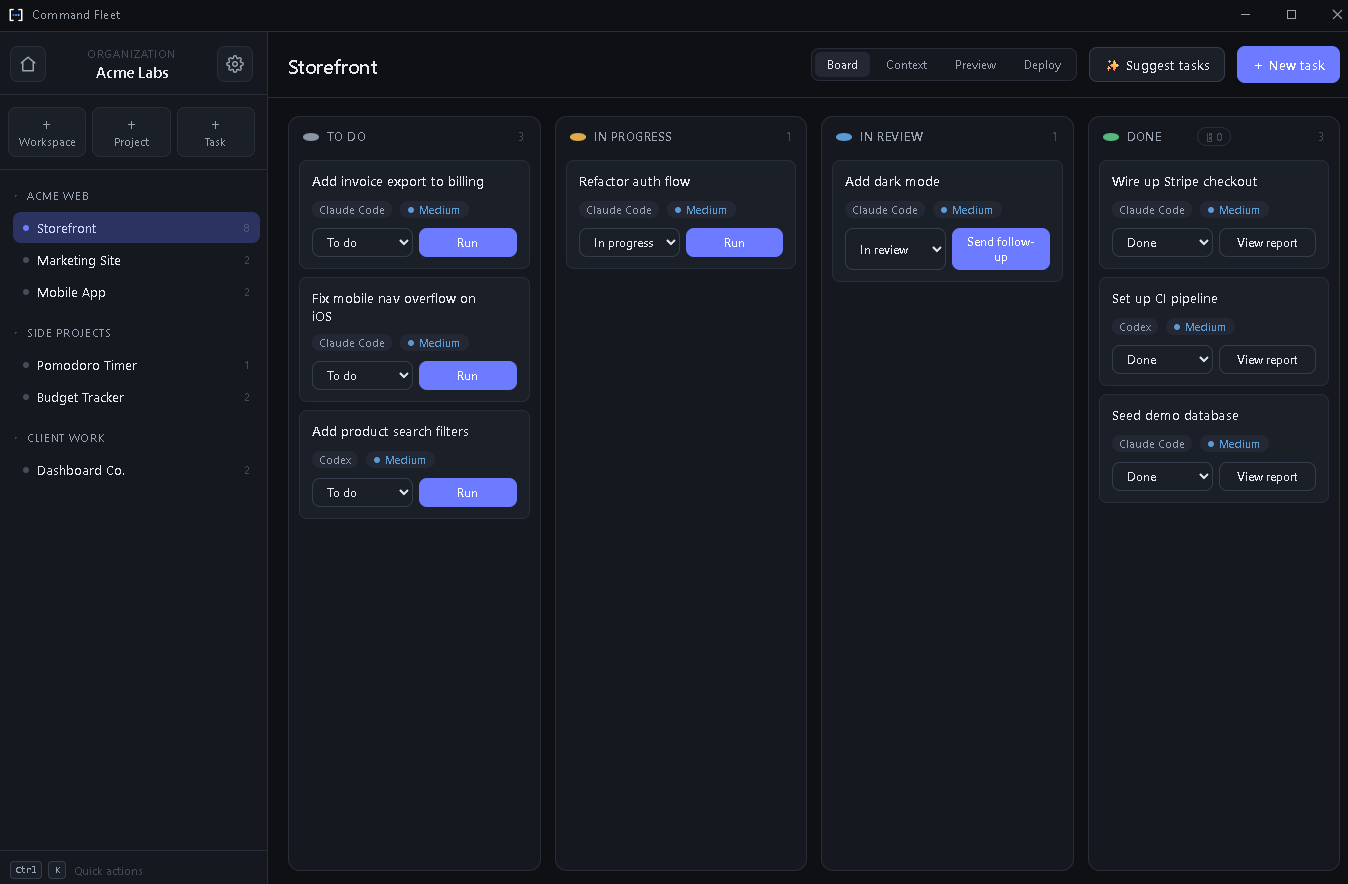
You stay the commander and the reviewer. Command Fleet handles the worktrees, streaming, diffing, merging, and deploys. There are two ways to work — pick per task.
The everyday loop for a single, well-scoped task.
Add a project, then describe the change in plain language. Attach a screenshot or spec if it helps.
Choose Claude Code, Codex, or Gemini and a model. An isolated worktree spins up automatically.
Output streams into the task history live. Send a follow-up to refine, or cancel anytime.
Read the in-app diff, run your verify gate, then merge the branch — or discard it cleanly.
Tell the workspace PM what you want. It plans the whole thing and drives a fleet of agents to build it — pausing only when it needs you.
Tasks declare dependencies. The scheduler only starts a task when its prerequisites are done — and runs independent ones in parallel.
If a task fails its verify gate, the loop retries automatically a set number of times, then leaves it In review for you.
Each finished branch auto-merges into the base, so the next task always builds on real, integrated progress.
Each project carries a context vault and house rules, so you never re-explain the basics. Pointers (repo URL, build folder, docs) go into the prompt; secrets stay in a separate vault that is never sent to any agent.
Start your 14-day free trial and run your first task in minutes.