"AI coding agent" gets used loosely, so let's pin it down. An agent is not a chatbot that gives you snippets, and it's not autocomplete. It's a program that can act in your codebase toward a goal. Here's a plain-English primer on what that means in 2026.
A simple definition
An AI coding agent is a program, built on a large language model, that can take a task and carry it out in a real codebase — reading files, running commands, editing code, and iterating toward a goal. The keyword is act: an agent doesn't just describe what to do, it does it, then shows you the result.
What an agent actually does
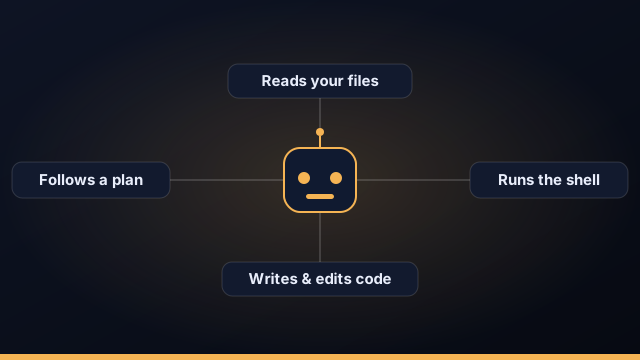
Concretely, a coding agent can:
- Read your files — search and understand the repository.
- Run the shell — install dependencies, run builds and tests.
- Write & edit code — make changes across multiple files.
- Follow a plan — work through a sequence of steps and recover from failures.
Agent vs autocomplete
Autocomplete predicts the next few tokens while you drive — useful, but you're still doing the work. An agent takes a whole task ("add pagination to the orders API") and executes it end to end, across however many files and commands it takes, then returns a diff. One speeds up typing; the other removes the typing.
Autocomplete is a faster keyboard. An agent is a worker you delegate to. Different tools for different jobs.
How you stay in control
Acting autonomously doesn't mean acting unchecked. In a well-designed setup, each agent runs in an isolated git worktree, secrets stay out of its prompts, and its output lands in a review queue. You read the diff, run a verify gate, and merge — or send it back. The agent does the work; you keep the judgment.
Agents in 2026: the big three
Three agents dominate serious use: Claude Code, Codex, and Gemini. Each has a personality and a set of tasks it's best at, which is why agent-agnostic tools let you pick per task instead of betting everything on one. If you're choosing, our guide to Claude Code vs Codex vs Gemini breaks down when to reach for each.
An agent is the difference between "AI that suggests" and "AI that ships" — with you at the gate.
How an AI coding agent works, step by step
Under the hood, an AI coding agent runs a loop. You give it a goal; it explores the repository to build context (reading files, searching for the relevant code); it forms a plan; it acts — editing files, running shell commands, installing dependencies, running the build and tests; it observes the results; and it iterates, fixing what failed until the task is done or it decides it's stuck. The large language model is the reasoning engine, but the agent is the wrapper that lets the model act: a set of tools (read file, write file, run command) plus the loop that calls the model, executes its chosen tool, feeds back the result, and repeats. That act-observe-iterate cycle is what separates an agent from a chatbot that can only describe what to do.
What people use AI coding agents for
In practice, AI coding agents handle a wide range of work. Common uses include implementing well-scoped features, fixing bugs from a description, writing and updating tests, performing multi-file refactors, bumping dependencies and fixing the fallout, scaffolding a new project, and migrating code from one pattern or framework to another. With an orchestrator on top, the same agents take on bigger jobs: an autonomous build loop can turn a one-sentence description into a planned, built, reviewed, and deployable app. The sweet spot is work that's concrete enough to specify and verifiable enough to review — give an agent a clear task with acceptance criteria and you can delegate it the way you'd delegate to a fast, literal junior engineer.
Getting started with AI coding agents safely
If you're new to AI coding agents, start small and keep the guardrails on. Pick one of the big three — Claude Code, Codex, or Gemini — and give it a single, well-scoped task with clear acceptance criteria. Run it in an isolated git worktree so a bad run touches only its branch, review the diff before you merge, and keep your API keys in your OS vault rather than a prompt. As you get comfortable, run several agents in parallel across projects and let an autonomous loop handle multi-step builds. The principle that keeps it safe at every scale is the same: agents do the typing, you keep the judgment — isolate the runs, review the diffs, and never put secrets where the model can see them. Command Fleet bakes all of that in, which makes it a gentle place to start.
AI coding agent terms, defined
A few terms come up constantly once you start working with AI coding agents. Here's a plain-English glossary:
- Agent — a program built on a language model that can act in a codebase (read files, run commands, edit code), not just chat.
- Orchestrator — a layer above agents that plans, dispatches, and integrates their work across tasks and projects.
- Git worktree — a second working directory backed by the same repository, used to isolate each agent run on its own branch.
- Task graph — a dependency-aware plan that records which tasks must finish before others, enabling safe parallel work.
- Verify gate — an automated build-and-test check that runs before a human reviews a change.
- Agent-agnostic — able to use any of several models (Claude Code, Codex, Gemini), chosen per task.
- Local-first — code, keys, and data stay on your machine rather than a cloud server.
Put together, these describe the modern shape of AI coding: agent-agnostic agents, run in isolated worktrees, coordinated by an orchestrator through a task graph, gated by review — which is exactly what a tool like Command Fleet provides, local-first, on your own machine.
Frequently asked questions
What is an AI coding agent?
An AI coding agent is a program built on a large language model that can act in a codebase: it reads your files, runs shell commands, writes and edits code, and follows a multi-step plan toward a goal — rather than just suggesting the next line.
How is an AI coding agent different from autocomplete?
Autocomplete predicts the next few tokens as you type, with you driving. An agent takes a task and carries it out across multiple files and commands on its own, then hands you a result to review.
What can an AI coding agent do?
Read and search a repository, run builds and tests, make multi-file edits, fix failures, and work through a planned sequence of steps. Within an orchestrator it can also run in an isolated worktree and route its result to review.
Which AI coding agents are there in 2026?
The big three are Claude Code, Codex, and Gemini. Each is strong at different tasks, which is why agent-agnostic tools let you choose per task rather than committing to one.
Put agents to work — safely
Command Fleet dispatches Claude Code, Codex, or Gemini per task, in isolated worktrees, with a review gate. Free for 7 days, no credit card.