"How much do AI coding agents cost?" has a frustrating but honest answer: it depends on how you pay and how you route the work. Prices move month to month, so instead of quoting numbers that will be stale by the time you read them, here's a durable framework for thinking about cost — and the two or three decisions that actually move it.
Two ways to pay: subscription vs API
There are broadly two pricing models. A subscription is a flat monthly fee for an agent like Claude Code, Codex, or Gemini — predictable, good for steady daily work. Metered API usage charges per token — flexible, and often cheaper for bursty automation that runs hard for an hour and then sits idle. Most builders end up using a subscription for their main driver and metered usage for spiky batch jobs.
The hidden cost: tool markups
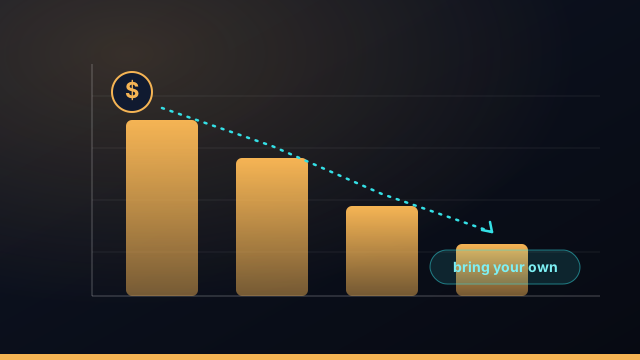
The most avoidable line item is a tool that resells model access. If a product bundles "AI usage" into its own price, you are usually paying a markup on every single run — once to the tool, and indirectly again for the model underneath. Bringing your own subscription means you pay the provider directly, at the provider's price, with no middle layer clipping each request.
If a tool bundles model usage into its subscription, assume you're paying twice for the same tokens. Bring-your-own keeps the meter honest.
Route by task to control spend
Not every task deserves your most expensive model. Dependency bumps, copy tweaks, and test scaffolding can go to a cheaper agent; the gnarly refactor gets the strongest one. Being able to choose the agent — and even the model — per task is the single biggest lever you have on cost, and it costs you nothing in quality because you're matching power to difficulty.
Parallelism changes the math
Running several agents at once uses more model time in the same wall-clock window, but it doesn't change the cost of any individual task. What it changes is throughput: you ship more in the same day. Measured the way that matters — cost per shipped feature — parallelism usually moves the number down, because your own time is the expensive part.
A simple cost framework
- Pay the provider directly with your own subscription; avoid resale markups.
- Match model strength to task difficulty — cheap for boilerplate, strong for hard problems.
- Cap concurrency to your budget, not your patience.
- Measure cost per shipped feature, not per token.
Where Command Fleet lands
Command Fleet is bring-your-own by design: you connect your own Claude, Codex, and Gemini subscriptions, so there's no resale markup and you're never double-charged for model usage. Because the agent is a per-task choice with an optional model override, controlling cost is just a routing decision you already make.
The cheapest token is the one you didn't need a senior model to write.
Frequently asked questions
How much do AI coding agents cost?
It depends on how you pay: a flat monthly subscription for Claude, Codex, or Gemini, or metered API usage per token. For steady daily work a subscription is usually the predictable choice; for bursty automation, metered usage can be cheaper.
Is it cheaper to bring my own subscription?
Usually, yes. A tool that resells model access adds a markup on every run. Bringing your own Claude, Codex, or Gemini subscription means you pay the provider directly and aren't double-charged for the same tokens.
How do I keep AI coding costs down?
Route by task: send boilerplate and routine edits to a cheaper model and reserve the strongest model for the hard refactors. Choosing the agent per task is the biggest lever on cost.
Does running agents in parallel cost more?
It uses more model time in the same window, but it doesn't change the per-task cost — and it dramatically increases throughput, so the cost per shipped feature often goes down.
Pay for models once
Command Fleet is bring-your-own — your Claude, Codex, and Gemini subscriptions, no resale markup, routing by task. Free for 7 days, no credit card.